
Please click below to access our SEND policy which is located within the policies section of our website.
Yattendon School
Special Educational Needs and Disability (SEND)
Information Report
The SEND Team – who are we?
- Kirsty Morgan – SEND Leader: kmorgan@yattendon.surrey.sch.uk
- Karen Burgess – Home School Link Worker
- Krystal Baker - ELSA
Our School Offer
Yattendon School complies with the requirements outlined in the Special Educational Needs Code of Practice 2014. We recognise and celebrate each other’s differences including personal skills, academic achievement and beliefs. Children’s learning needs can be diverse and we aim to meet the needs of all our children through a broad and balanced, inclusive curriculum and understand the deep benefits to all children when children with and without SEN learn, socialise and play together.
If a child has a special educational need we aim to identify this as soon as possible so that we can put in the appropriate support; this may be as a result of scrutinising pupil data and screening. This may take the form of a short term ‘catch-up’ programme, to address a difficulty with spelling, for example, or a longer term intervention to support with speech and language or fine motor skills difficulties. We encourage all our children to become fluent readers and provide individual and small group programmes to promote this. We work in partnership with parents and carers and try to meet with them regularly at parent consultations, annual review meetings and less formally at coffee mornings, drop-ins and whenever a parent/carer requests a conversation about their child.
We have an experienced and well-trained team of Learning Support Assistants (LSAs), who work one to one and with small groups of children and we invest in staff training so that programmes recommended by specialists can be carried out by our school-based staff. We have good accessibility for children with impaired mobility, including disabled toilet facilities, a lift and many of our classrooms are large enough to accommodate a child who uses a walking frame or wheelchair. Please also see the Accessibility Policy in our policy section on the Yattendon website.
Please see also our Special Educational Needs and Disabilities Policy which can be found on the policy section of the website.
SEND Register
Under the Children and Families Act 2014, the definition of ‘Special Education Needs’ or SEN is broader than before. Originally, a child had SEN if he or she had a learning difficulty which called for special educational provision (SEP) to be made for them. So children and young people with disabilities (and not just learning difficulties) are all now included within the meaning of SEN. This also includes children with social, emotional and mental health (SEMH) needs.
We aim to identify if a child has SEN as efficiently as possible. This information details our approach:
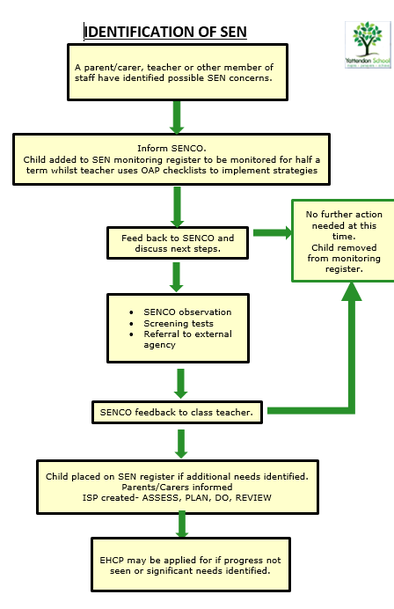
The register is ‘fluid’ meaning that once a child has made adequate progress or no longer requires additional support, they can be removed from the register. All educational institutions that are subject to the SEND Code of Practice are required to make reasonable adjustments to ensure that pupils are not disadvantaged by their SEN or disability.
We adopt a graduated approach to education, implementing an ‘assess, plan, do, review’ cycle to monitor children's’ development. If it becomes apparent that an individual is not making the expected progress, then we may make educational provision which is additional to, or otherwise different from, that for others of the same age.
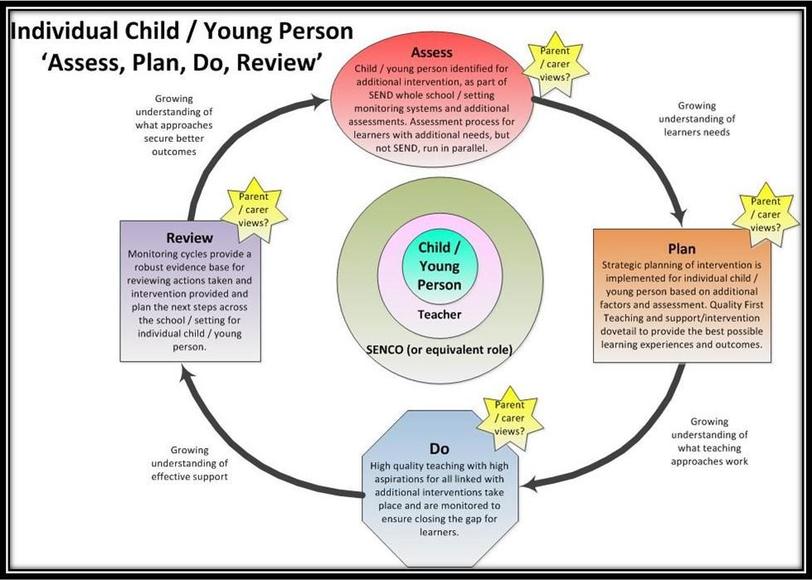
Where necessary this can include bringing in external help, for example by having an outside therapist come into the school on particular days to work with an individual or assigning a Learning Support Assistant (LSA) to support a child in the classroom. All children on the SEND Register will have an individual support plan (ISP) created for them which enables the ‘APDR’ process to develop. Individual targets are set and reviewed termly.
We work closely with a variety of outside agencies including the Educational Psychologist (EP) who offers advice for specific children in relation to their barriers to learning. She also carries out specific screening tests to further our understanding of a child's cognitive skills.
The STIP Team (Specialist Team for Inclusive Practice) and SALT (Speech and Language Team) are also regular visitors to the school and again provide specific guidance, targets and resources to further support the learners in the classroom.
If your child requires further support
If a child or young person needs more support than can be provided within a school’s own resources and budgets, the school can request that the Local Authority (‘LA’) conduct an ‘EHC Needs Assessment’ of the child's SEND for the purpose of making an Education, Health and Care Plan (also referred to as an EHC plan or EHCP).
An EHC plan is a legal document that describes the child or young person's special educational needs and associated health and social care needs. It also sets out the provision and support they must receive and in some cases names a Specialist Provision or other placement. An EHC plan will also outline the child or young person's goals and ambitions in life and describe the outcomes sought for the child or young person.
Despite high quality teaching and purposeful intervention, through the school based core offer, a small number of children and young people may make inadequate progress towards their identified outcomes. Where pupils are making inadequate progress given their age, starting point and particular circumstances, it may be appropriate to consider whether an EHCP is needed.
This is likely to be the case for children who present with multiple special educational needs of an interrelated and enduring nature and who require more highly specialised and personalised arrangements accessed through an EHCP in order to achieve their outcomes. The arrangements required to be put in place in order for children/young people to progress would be beyond those available through the school based core offer - i.e. the cost of the necessary arrangements would exceed £6,000.
In summary an EHCP is likely to be beneficial in channelling support for children and young people with multiple special educational needs of an interrelated and enduring nature who require support over and above that available through the school based core offer in order to make adequate progress in relation to their age, starting point and particular circumstances.
An EHC plan is only issued if the child’s needs cannot be met within the resources normally available to mainstream schools in the area and if the school cannot reasonably be expected to provide the support. The vast majority of children with SEN will have their needs met at the school-based levels of support.
The Local Offer
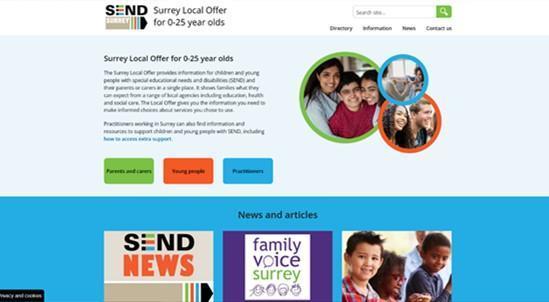
The purpose of the Local Offer is to enable children and young people with Special Educational Needs and/or Disabilities and their parents to see more clearly what services are available in their area and how to access them. More importantly, it will provide a way for families and young people to more easily engage with services and information that can benefit them. The offer will include provision from birth to age 25, across education, health and social care and should be developed in conjunction with children and young people, parents and carers and local services, including schools, colleges, health and social care agencies.
Surrey Local Offer Website https://www.surreycc.gov.uk/children/support-and-advice/local-offer
Please see below FAQ's